 how-to
How to Avoid Overweight Baggage Fees
Table of Contents
- Understand Airline Checked Baggage Weight Limits Before You Travel
- Weigh Your Luggage at Home to Avoid Surprises
- Redistribute Heavy Items Across Your Bags
- Use Lightweight Luggage Packing Tips to Reduce Bulk
- Maximize Your Carry-On Baggage Allowance
- What to Do If Your Bag Is Overweight at Check-In
- Step 1: Stay calm and ask for the exact weight
- Step 2: Ask to redistribute items to your carry-on or personal item
- Step 3: Ask whether an extra checked bag is cheaper than the overweight fee
- Step 4: Ask about purchasing additional allowance on the spot
- Step 5: Consider shipping items separately
- Step 6: Know when to walk away and repack
- What to say at the counter
- When to purchase an extra bag versus paying the fee
- Plan Ahead: Compare Costs and Book Extra Baggage Early
- Frequently Asked Questions
Last Updated: October 9, 2026
Understand Airline Checked Baggage Weight Limits Before You Travel
The first step to avoiding overweight baggage fees is knowing your airline's weight rules before you pack.
Check your airline's baggage policy the moment you book your flight.
Here's what to check:
- Standard checked baggage weight limit
- Number of free checked bags included in your fare
- Baggage fees for overweight or extra bags
Write down these limits. Take a photo of the policy. You'll need this information when you pack.
Weigh Your Luggage at Home to Avoid Surprises
The second critical step is weighing your luggage before you leave for the airport. This single action prevents surprises at check-in and gives you time to adjust your packing.
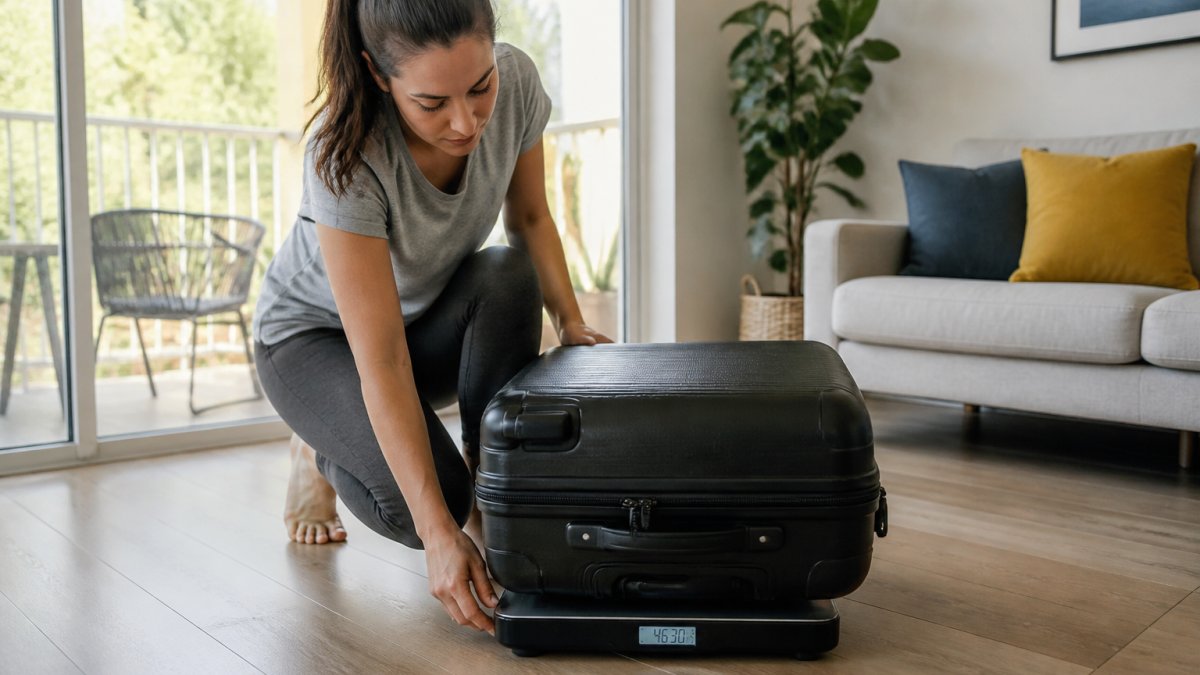
Weigh your empty suitcase first. Most luggage weighs between 2kg and 4kg depending on size and material. Then pack your items and weigh again.
What scales work best for luggage
A digital bathroom scale works if you don't have a luggage scale. Stand on the scale holding your empty bag, note the weight, then stand holding your packed bag.
A dedicated luggage scale is more accurate. These portable scales hang from your hand or sit under your bag.
How to weigh accurately and plan your packing
Weigh your bag multiple times on the same scale to confirm the reading. If you're close to the limit, weigh it on a different scale to be sure.
Once you know your weight limit, plan what goes in your checked bag versus your carry-on. Heavy items like shoes, books, and toiletries should be distributed strategically across both bags.
Redistribute Heavy Items Across Your Bags
If your checked bag is overweight, the simplest fix is spreading items across multiple bags.
Shoes, jackets, and toiletries are dense and heavy. Shift these to your hand luggage if space allows.
This approach works best if you're only slightly over the limit (1-3kg). If you're significantly overweight, you'll need a different strategy.
Steps to redistribute weight:
- List the heaviest items in your checked bag
- Identify which items can safely fit in your carry-on
- Move them one by one until your checked bag meets the weight limit
Use Lightweight Luggage Packing Tips to Reduce Bulk
Packing smarter reduces weight and bulk without sacrificing what you bring. The goal is fitting more into less space and using less material overall.
Compression techniques and packing cubes
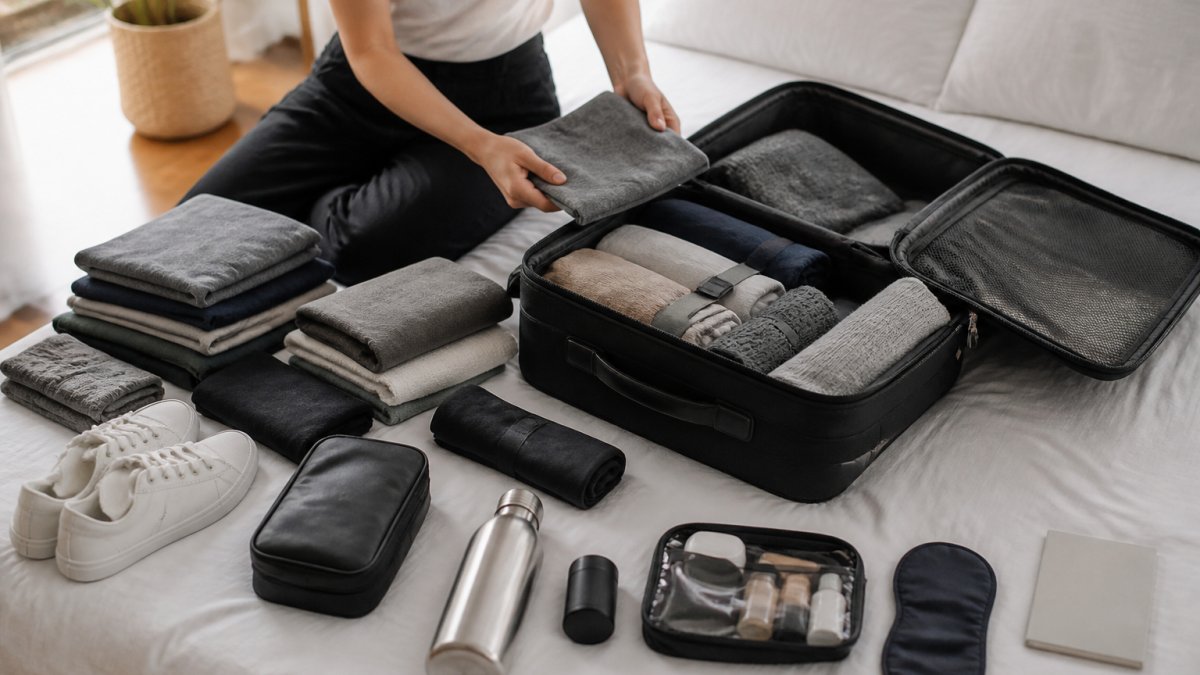
Packing cubes organise your clothes and reduce air pockets. Roll clothes tightly instead of folding them.
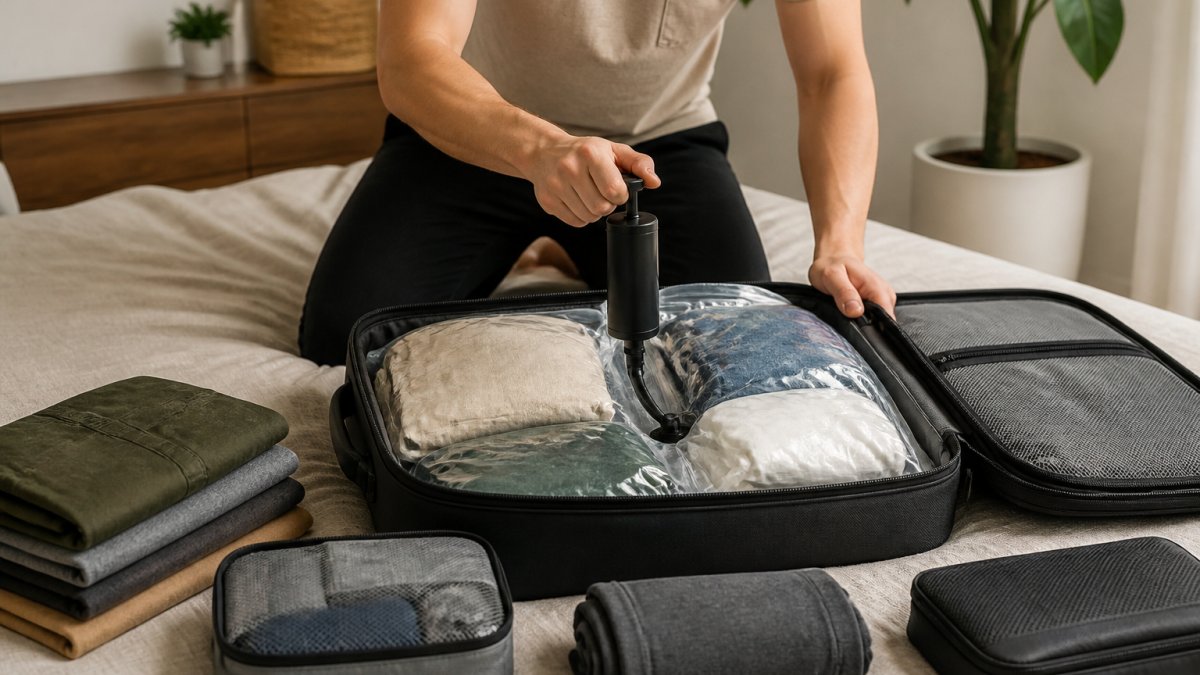
Compression bags remove air from clothing bundles, reducing volume significantly. These work best for bulky items like jumpers, jackets, and bedding. Vacuum compression systems are more effective than hand-rolled bags.
Choose lighter materials and wear heavier items
Select lightweight luggage made from modern materials like polycarbonate or ballistic nylon. Older or heavier suitcases eat into your weight allowance before you've packed a single item.
Wear your heaviest clothing items during travel instead of packing them. A thick winter coat, hiking boots, or heavy jumper can weigh 2-4kg.
Other weight-saving tactics:
- Wear layers instead of packing bulky single pieces
- Use a lightweight backpack as your personal item
- Pack only travel-sized toiletries
Maximize Your Carry-On Baggage Allowance
Your carry-on allowance is a powerful tool.
Use this space strategically. Heavier items in your carry-on don't count toward checked baggage weight limits.
The key is understanding your airline's carry-on size and weight limits.
Pack your carry-on with:
- Electronics and chargers
- Important documents and medications
- Valuables and jewellery
This approach balances convenience with compliance. You keep essentials within reach while reducing checked baggage weight.
What to Do If Your Bag Is Overweight at Check-In
Despite your best efforts, your bag might still be over the limit when you reach the counter. What you do in the next few minutes can determine whether you pay a fee or walk away with your wallet intact. Here is a step-by-step plan.
Step 1: Stay calm and ask for the exact weight
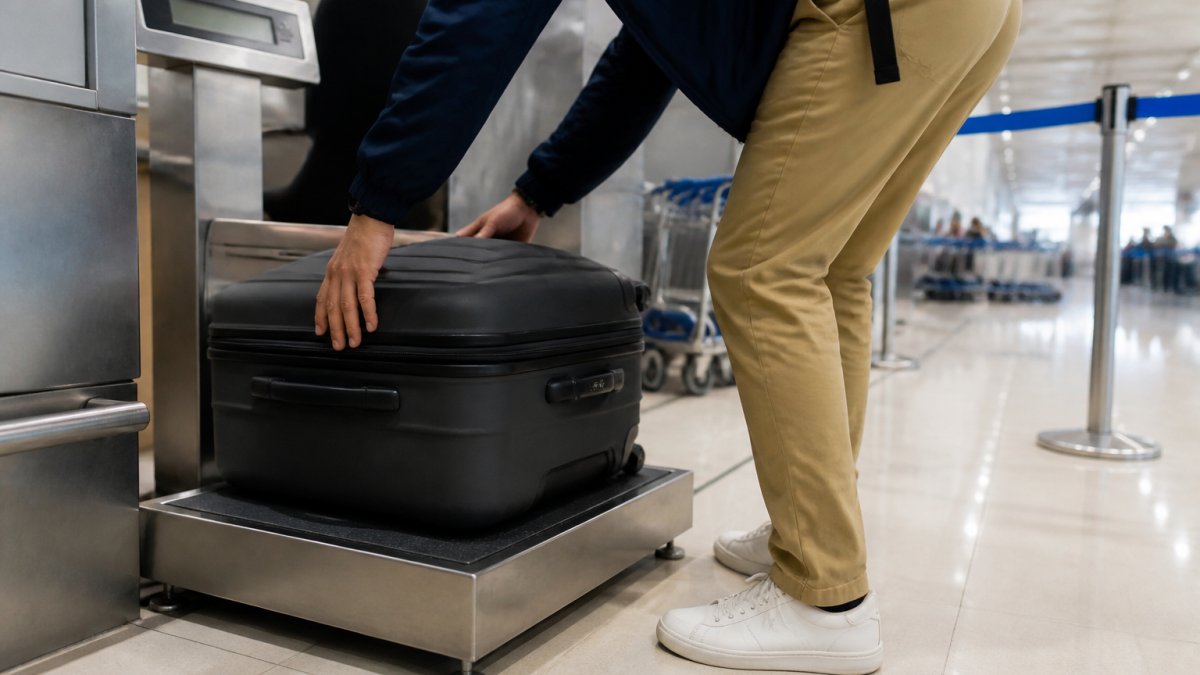
Before you agree to anything, ask the agent to show you the scale reading. Airport scales can vary, and knowing the precise number tells you how much you need to remove. If you are only 1-2kg over, redistributing items may solve the problem immediately.
Step 2: Ask to redistribute items to your carry-on or personal item
Most airlines allow you to move items between bags at the counter, provided your carry-on then meets its own size and weight limits. This is the cheapest fix because it costs nothing. Remove the heaviest dense items first, shoes, books, toiletries, chargers, and place them in your carry-on or personal item.
Step 3: Ask whether an extra checked bag is cheaper than the overweight fee
If redistribution is not enough, ask the agent for two prices: the cost of an additional checked bag and the cost of paying the overweight fee. In many cases, buying an extra bag is cheaper than paying a per-kilogram overweight charge, especially if you are more than 3-5kg over.
Step 4: Ask about purchasing additional allowance on the spot
Some airlines let you buy extra weight allowance at the counter, though it is almost always more expensive than prepaying online. If the agent offers this, compare it against the extra-bag price before deciding.
Step 5: Consider shipping items separately
If you are significantly over and the fees are high, ask whether the airport has a courier or shipping desk. Sending a small parcel to your destination can cost less than an overweight fee, particularly for heavy but low-value items. This is rarely the fastest option, but it can be the cheapest for non-urgent items.
Step 6: Know when to walk away and repack
If none of the above works and you have time before your flight, step aside from the counter and repack in the terminal. Remove items you can live without, wear extra layers, or move items into your personal item. You can then return to the counter once your bag is under the limit.
What to say at the counter
Be polite and specific. A useful script: "I think my bag is slightly over. Can you tell me the exact weight and whether it would be cheaper to add an extra bag or pay the overweight fee?" This gives the agent a clear choice and often results in them offering the cheaper option.
When to purchase an extra bag versus paying the fee
Use this simple decision rule:
- If you are 1-3kg over: redistribute items to carry-on or personal item.
- If you are 3-7kg over: compare the extra-bag price against the overweight fee; the extra bag is often cheaper.
- If you are more than 7kg over: an extra bag or shipping is almost always cheaper than the overweight fee.
Frequent flyers often have free or discounted extra baggage allowances. Check your loyalty account before paying any fee. If you are travelling on a premium cabin ticket or with a higher-tier frequent-flyer status, you may already have extra baggage included. Confirm this before accepting a fee.
Plan Ahead: Compare Costs and Book Extra Baggage Early
Booking extra baggage in advance is almost always cheaper than paying at the airport, but the cheapest option depends on your specific situation. This section gives you a decision framework to compare the real costs before you leave home.
The three main options and their typical costs
When your luggage is over the limit, you generally have three legitimate choices:
- Pay an overweight fee at the airport, typically $75-$150 for 5kg over, depending on the airline and route. This is the most expensive option and should be avoided if possible.
- Buy an extra checked bag, prepaid online, this often costs $30-$60 for one extra bag. At the airport, it may cost $50-$100. This is usually cheaper than an overweight fee if you are more than 3kg over.
- Ship items separately, courier or postal services can cost $20-$80 for a small parcel, depending on weight and destination. This is best for heavy, low-value items you do not need immediately.
How to compare costs before you book
Use this simple calculation:
- Weigh your packed bag at home.
- Subtract your airline's weight limit to find how many kilograms you are over.
- Look up your airline's overweight fee per kilogram (often listed on its baggage page).
For example, if you are 5kg over and the overweight fee is $20 per kilogram, that is $100. A prepaid extra bag at $40 is clearly cheaper. If you are only 1kg over, redistributing items is free and best.
When prepaid baggage is worth it
Prepaid baggage is worth it if:
- You know you will exceed the standard allowance.
- You are travelling on a budget fare that includes no checked bag.
- You are travelling with sports equipment or bulky items.
Some airlines offer discounted prepaid rates only up to 24 hours before departure. Check the cut-off time when you book.
Loyalty programmes and fare bundles
Frequent-flyer programmes often grant free baggage allowances based on status tier. If you are close to a status milestone, reaching it before your trip could eliminate baggage fees entirely. Budget airlines frequently bundle baggage into fare packages, a "Plus" or "Premium" fare may include extra baggage at a lower overall cost than buying it separately.
A note on route and fare differences
Baggage rules can vary by route, ticket type, and frequent-flyer status. A bag that is free on one route may incur a fee on another. Always verify the applicable allowance for your specific booking, not just the airline's general policy. Check your booking confirmation or the airline's website using your flight number.
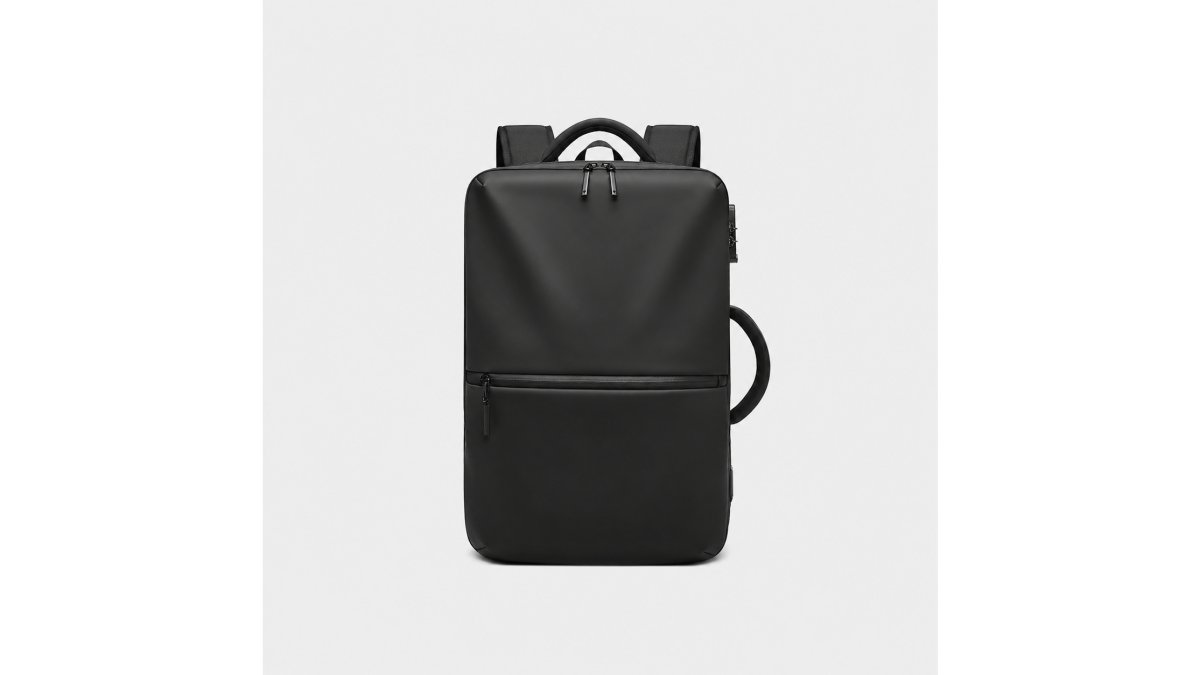
At VentureBuilt Co., we understand that smart packing starts before you leave home. Our vacuum compression travel backpack is designed to help you maximise packing efficiency and reduce the bulk of your luggage through intelligent design. The included air pump lets you compress clothing and gear further, giving you more capacity without adding bulk. This approach, combining smart packing tools with strategic weight distribution, helps travellers stay organised on any adventure.
Key planning steps:
- Review your airline's baggage policy when booking
- Weigh your luggage at home
- Decide whether prepaid baggage is worth the cost for your trip
Frequently Asked Questions
What happens if your bag is 1 kg or 2 kg overweight?
Most airlines charge a flat fee for checked baggage that exceeds the weight limit, typically ranging from $30 to $75 depending on the carrier and route. A 1 kg or 2 kg overage incurs the same fee as being significantly over, there's usually no graduated penalty. The best approach is to repack before check-in: remove items to personal luggage, shift weight to carry-on baggage if space allows, or purchase prepaid extra baggage during booking, which often costs less than paying the fee at the airport.
How much does excess baggage typically cost if I don't avoid overweight baggage fees?
Overweight baggage fees vary by airline and route but commonly range from $30 to $100 per bag for a single-kilogram overage. International flights often charge more than domestic routes. Prepaid extra baggage, purchased during or shortly after booking, usually costs 40-60% less than paying at the airport. Check your airline's baggage policy on their website before travel to confirm exact fees for your flight and consider whether purchasing an additional checked bag in advance would be cheaper than managing weight restrictions.
Can I move items from checked baggage to carry-on to reduce weight?
Yes, moving items from your checked bag to carry-on baggage is a legitimate way to avoid overweight baggage fees, provided your carry-on stays within the airline's weight and size limits. Most carriers allow a carry-on bag (typically 7-10 kg) plus a personal item. At check-in, if your bag is overweight, ask to repack at the counter and transfer items to your carry-on or personal bag. This strategy works best if you've left headroom in your carry-on allowance, plan your packing with this flexibility in mind before arriving at the airport.
What's the best way to weigh luggage at home before a flight?
Use a digital luggage scale (available at travel shops or online retailers) or a bathroom scale: place your suitcase on a digital scale for a direct reading, or weigh yourself, then weigh yourself holding the suitcase and subtract the difference. Weigh your bag fully packed 24-48 hours before departure so you have time to adjust contents. Weigh it again the morning of travel to account for any last-minute additions. Check your airline's exact weight limit (often 20-23 kg per checked bag) and aim to stay 1-2 kg under to account for scale variations and airline tolerance.
Avoiding overweight baggage fees comes down to planning and smart packing. Understand your airline's rules, weigh your luggage before leaving home, and distribute weight across your bags strategically. If you're a frequent traveller, investing in lightweight, well-designed luggage and compression tools pays for itself within a few trips. Start with these steps on your next journey, and you'll arrive at your destination without surprise charges and with everything you need.